


When Angela Coldwell describes the origins of Honour the Work, she begins with a familiar scene: a career fair where students stare blankly when told their marketing or business skills could fit into construction.
“They had never thought about it before,” says Coldwell. “It was a realization that there was a lack of awareness about what the opportunities were in the construction industry.”
That moment of revelation became a spark for Coldwell, a longtime teacher; her husband Tim, who rose from engineering student to president of a national construction firm; and their friend Jen Hancock, vice-president at Chandos Construction and ECA board member. The three shared a growing concern about Canada’s looming skilled‑trades shortage and decided to act.
“Around the time the pandemic happened, my husband looked at me one day and said, ‘Why don’t we do something about it?’” says Coldwell.
Formally launched in November 2022, Honour the Work was born from those conversations and months of research, which revealed a fragmented landscape. There were scholarships and pre-apprenticeship programs across the country, but there was no single hub connecting them. The teacher in her quickly saw a different path — one that began not with job fairs or policy reports, but with children.
“My thought immediately went to teaching youth with parents,” she says.
That impulse—to educate through connection—became the foundation of the organization. What started as a website and social media campaign has evolved into a multifaceted charitable initiative that partners with construction associations, companies and school districts. Today, Honour the Work delivers hands-on STEAMS Kits to Grades 1 through 6, matching lessons to provincial curricula.
“The goal now is to be able to reach elementary schools,” Coldwell says. “We build hands-on kits matched to the curriculum. They have materials and children’s books so that kids can actually see themselves in careers.”
This fall, seven Edmonton schools were chosen to receive kits, five with support from the Edmonton Construction Association (ECA) and two sponsored by Mattamy Homes.
Sheena Drummond, ECA’s education and workforce development coordinator, says the association saw an immediate connection to its broader goals.
“We, as an industry, currently have a huge deficit,” says Drummond. “We need more young people to see the construction industry or skills as a viable option as they prepare for the world of work and career.”
Both leaders emphasize that Honour the Work’s mission is to change deeply embedded perceptions.
“Generally speaking, teachers – and I include myself in this – went to K to 12, then to university, then back to the classroom,” says Coldwell. “So, overall, we do lack, generally speaking, an awareness for different careers that are not college and degree programs.”
The result is a generation of children who rarely see construction as intellectually engaging or innovative.
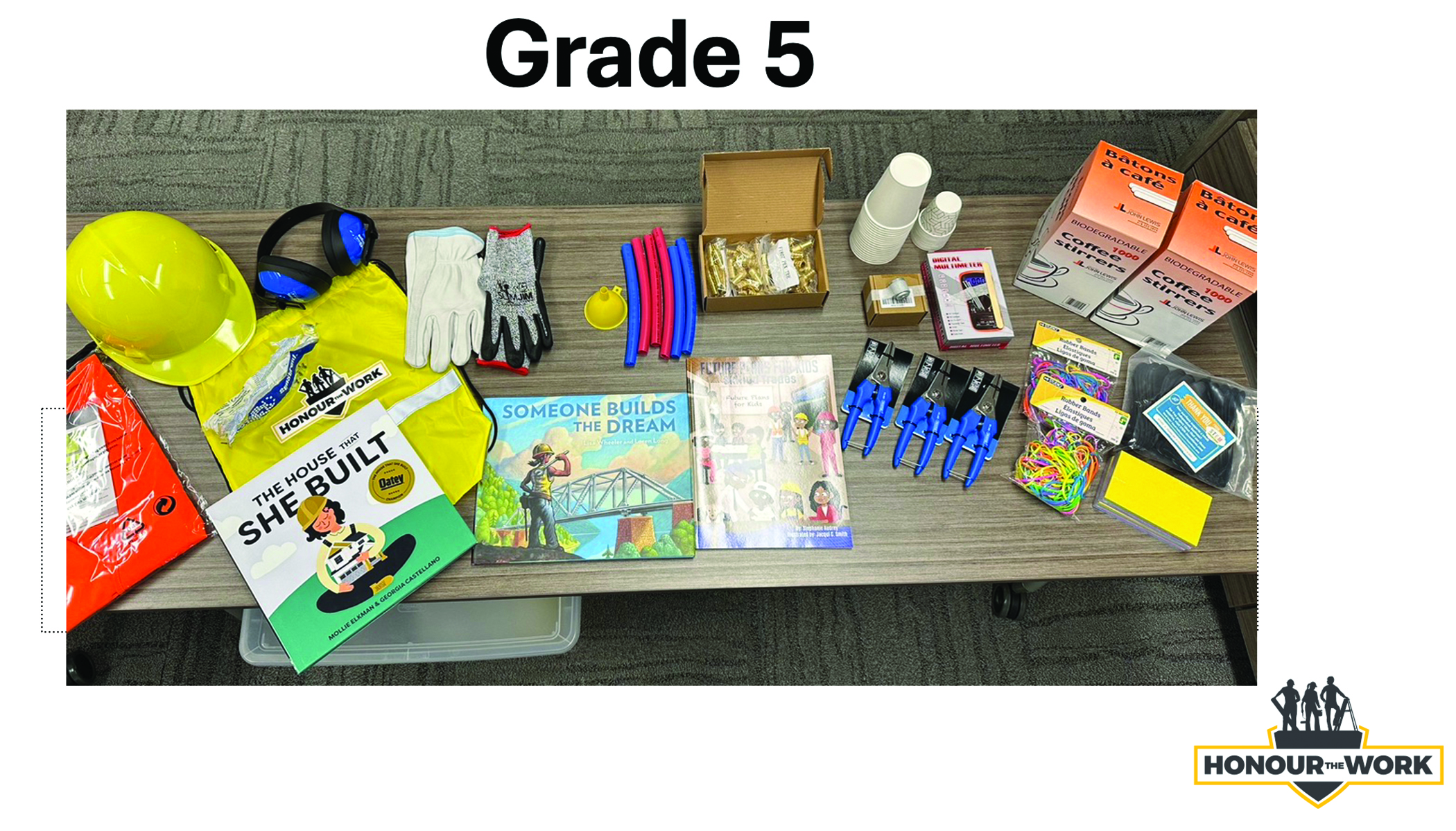
The kits themselves are playful but powerful correctives. Each is designed to connect skilled trades to the concepts that students are already learning. Grade 2 students, for instance, play at being masons with sugar cubes, while Grade 3 students build hydraulic cranes using tubing and syringes. Safety and sustainability lessons are woven throughout.
“Teachers in Grade 3 are going to showcase how to make concrete,” Coldwell notes. “One of the companies identified is CarbonCure out of Halifax, and what they’re doing to sequester carbon dioxide by mixing it with cement.”
In Grade 5, lessons explore personal protective equipment, inviting young learners to design or redesign their own PPE.
“Wherever we could tie in innovation, we have,” Coldwell says. The program spotlights homegrown ingenuity, from Canadian exoskeleton technology to harness systems that are improving worker safety.
The charity’s strategy is guided by data about childhood development and bias formation.
“Research supports the fact that children create gender biases between ages five and seven, and that girls in particular start to lack STEM confidence in Grade 4,” explains Coldwell, adding that those are precisely the grades Honour the Work focuses on—where curiosity can still rewrite what’s possible.
For Coldwell, the ambition is to intervene before stereotypes harden.
“Starting in junior high or high school is too late,” she says. “We need kids to be informed and their parents and teachers to be career aware.”
The hope is that, as awareness ripples outward, more young people will enter high school already open to careers that are highly impactful, highly lucrative, can’t be outsourced by robotics or AI and are needed for everything from the affordable housing crisis to clean energy transitions.
For the ECA, Honour the Work represents both community engagement and workforce strategy. Drummond has seen firsthand how the trades remain misunderstood.
“We want to change the mindset,” says Drummond. “You could still be academically brilliant and go into construction. It is a viable career path. It is very lucrative, and there is opportunity to grow and to build.”
Teachers who used the kits in other provinces have echoed that sentiment.
“Regardless of whether it’s Alberta, Ontario or B.C., the biggest thing is that teachers all say they just didn’t know these careers existed,” says Coldwell. “For many, the experience has exposed how relevant and hands-on these lessons are, connecting curriculum to real-world careers.”
Drummond admits that the program’s outcomes can’t easily be quantified in budgets or job counts and that it may not be an immediate gratification. The trickling-down effect they expect to have is more young people being aware of careers within skilled trades, getting the right information and eventually taking up these roles. The ECA plans to follow up with teachers next year.
“When I communicated with the teachers just to get some feedback… they were just so appreciative,” says Drummond. “They talked about how it transformed the learning experience for the students.”
Both women see Honour the Work not as a single campaign, but as a cultural shift.
“Our hope is that the government perhaps would be part of such an initiative, and it eventually should be mandated that all schools receive and benefit from such a program,” says Drummond. “I believe it’s a game changer. It changes the way that we see education.”