


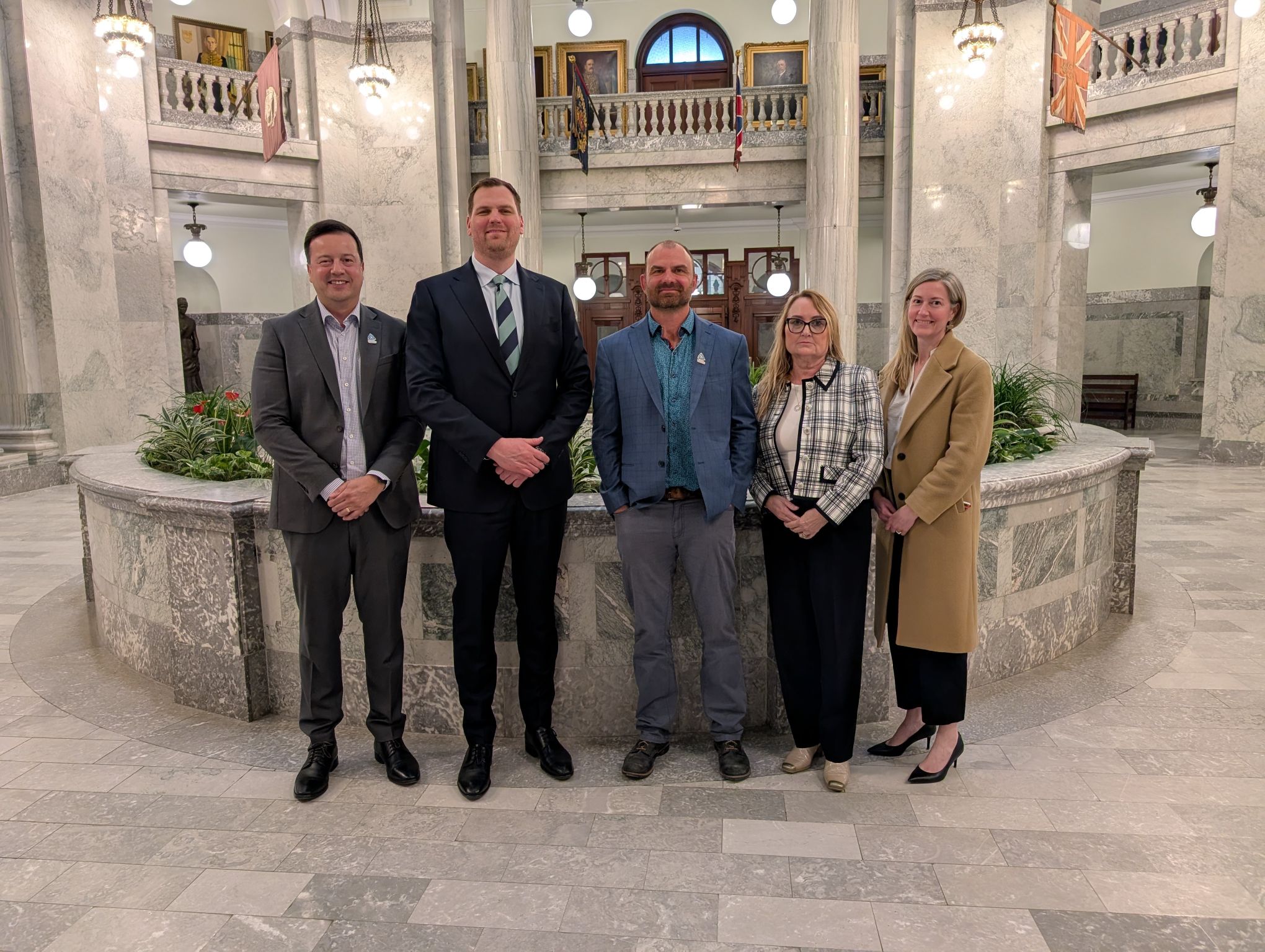
For much of its history, the Edmonton Construction Association (ECA) operated in a familiar posture: a respected local organization that networked its members, served its community and deferred to the Alberta Construction Association (ACA) when provincial matters arose. Its relationship with the City of Edmonton was effective, if sparing. Federal engagement was largely episodic. The idea that government relations would one day be embedded into the ECA’s corporate strategic plan would have seemed, to many, like an ambitious stretch.
Today, it is simply how the association operates.
Brookes Merritt, CEO of Loyalton Strategies and the ECA’s government relations consultant, has had a front row seat to that evolution.
“We’ve come a long way in just a few short years,” says Merritt. “Today, the association asserts more deliberate agency over those relationships. We are actively seeking opportunities to show government that we are a trusted partner in developing sound public policy, at every turn.”
The arc of that transformation runs through some of the most turbulent economic and political terrain Alberta has navigated in a generation. The first two decades of the 21st century saw the largest oilsands investments since the 1970s flow through Edmonton and the capital region, reshaping the construction market and demanding a more sophisticated policy response. As Merritt describes it, Edmonton served as the closest industrial hub through which all major oilsands expansion projects ran, generating a significant volume of commercial and industrial work and forcing the policy environment to keep pace with volatile resource markets. Then came the trend toward urbanization, rapid population growth and a refocusing of the industry’s interests on more granular, civic-level policies. The ECA’s provincial-level advocacy initiatives grew from there and helped shape the current era of advocacy from the Alberta Construction Association.
Two pieces of legislation stand out in that evolution. The Prompt Payment and Construction Lien Act (known as the PPCLA) overhauled Alberta’s decades-old Builders’ Lien Act, mandating strict 28-day payment timelines from project owners to general contractors, a seven-day trickle-down payment requirement to subcontractors and establishing a rapid, binding dispute adjudication process outside the court system.
Before the PPCLA was in place, construction markets often operated in what Merritt calls a “pay-when-paid” culture, especially for smaller companies. Trade contractors routinely waited several months for payment, suffocating cash flow for small- and medium-sized companies. Bringing the voice of those companies, and of trade contractors, to the provincial table – and arming the ACA with those stories – helped cement the need for change. Amendments ensuring provincial infrastructure projects played by the same rules was, in Merritt’s view, among the ECA’s most advocacy wins for the sector.
“That’s an example the ECA is really proud of, where the work of local construction associations fed into the ACA’s provincial advocacy and strengthened our provincial voice, one that delivered real financial predictability for members. That collaboration was also evident in the ACA’s work to modernize procurement contracts,” says Merritt.
“Those are wins that few outside the industry would recognize, but their impact on managing construction costs is direct and ongoing.”
Merritt adds that the ECA’s direct connection to general and trade contractors is essential. He says that throughout the year, they are making space for our members to bring these concerns forward as their testimonials are some of the sharpest arrows in the ACA quiver.
“Our industry benefits from these shared efforts,” he says.
More locally, the Municipal Government Act and the Community Revitalization Levy (CRL) framework have given Edmonton a mechanism to borrow against future property tax revenues in designated zones to fund public infrastructure. The CRL, Merritt argues, is the primary reason Edmonton’s modern skyline looks the way it does today. It underwrote the development of ICE District, which is a project that benefited the city broadly and ECA members specifically.
The playbook for achieving those kinds of wins has changed substantially.
“The 2000 playbook relied heavily on boardroom handshakes and reactive complaining when things went wrong,” Merritt says. “In 2026, effective advocacy is more sophisticated. It’s based on a combination of data and leveraging relationships that have often been years in the making. At its core, government relations are indeed relational – especially in Edmonton. The business environment in a lot of other Canadian cities can often feel transactional. Edmonton still has that small-town feel, where businesses collaborate to lift each other up. That’s a tremendous trump card when dealing with government. It’s hard to outflank our industry.”
Outside of its work with the ACA, the ECA has collaborative efforts in economic data and multi-sector coalition building, working through the Municipal Advocacy Roundtable alongside BILD, NAIOP and BOMA, and maintaining regular engagement with the City of Edmonton’s Infrastructure Services department. Those forums have become, in Merritt’s description, safe spaces for industries to develop unified solutions and move the needle on complex files. Campaigns like “We Build This City” use hard data to demonstrate how municipal delays or unfair procurement directly drive up consumer costs and slow housing supply.
“What makes it work is changing the narrative from demands to solutions,” says Merritt. “When government sees us as co-designers of Edmonton’s growth — offering predictable infrastructure and balanced risk frameworks — doors open and real policy collaboration begins.”
At the municipal level in 2026, the most active files involve permitting timelines and procurement risk allocation. Members cannot afford to have capital tied up in administrative backlogs while navigating high interest rates, and the ECA has been pushing back against contract clauses that attempt to shift unpredictable project liabilities entirely onto contractors. Through joint initiatives with NAIOP and BOMA, the association is pressing for a transparent procurement framework built on collaborative delivery models, one that makes bidding on municipal work fair, predictable and financially viable for local firms.
At the provincial level, the ECA’s influence has deepened by working in lockstep with the ACA rather than in parallel to it. Key relationships are anchored in Alberta Infrastructure; Alberta Advanced Education; and the Ministry of Jobs, Economy, Trade and Immigration, as well as with senior bureaucrats managing capital planning. By hosting post-budget roundtables and providing real-time market snapshots, the ECA has shifted from outside lobbyist to trusted advisor.
“Ministers know that consulting the ECA means getting an accurate, unvarnished pulse of the Edmonton region’s industrial capacity,” Merritt says, adding that he is emphatic about the ACA’s role in that success. “The ACA has put in the time to become the most influential, legitimate and valuable representative of our industry at the provincial level. That benefits our association and our members.”
Federally, the ECA is engaged through the Canadian Construction Association on three interconnected priorities: securing stable, long-term infrastructure funding; widening immigration pathways for skilled trades and monitoring global trade risks and tariff impacts on material affordability. Those three federal files, Merritt notes, are not separate from the provincial and municipal picture, they are structurally linked to it. Federal infrastructure dollars require provincial matching grants. Immigration targets dictate who can be hired and what can be built; and, everything ultimately lands at the municipal level, where permitting bottlenecks and procurement models determine whether projects actually break ground.
“If one level falters on funding, immigration, or zoning, the entire pipeline stalls,” he says. “The ECA connects those dots.”
Major economic disruptions have accelerated that integration. The 2008 recession, the oil price crashes and the COVID-19 pandemic each pushed the ECA’s relationship with government from transactional toward something more operational. The pandemic, in particular, turned the association into what Merritt describes as an essential, daily advisory hub for health protocols and supply-chain logistics. Post-pandemic inflation and sudden tariff threats have since forced the ECA into continuous, proactive economic forecasting.
“Today, we don’t just ask for project funding,” he says. “We co-manage economic volatility alongside public partners.”
Between 2000 and 2026, Edmonton has grown into a city that requires exactly that kind of partner, one that shows up not just when things go wrong, but every day before they do. For ECA members, Merritt’s message is unambiguous.
“Edmonton is the best city in Canada to build in, and we’re working to protect that title by surrounding our members with support,” says Merritt. “We are at your back, protecting your bottom line behind the scenes. We are out in front, shaping the landscape for today and tomorrow with politicians and government leaders. We are walking alongside you every step of the way.”