


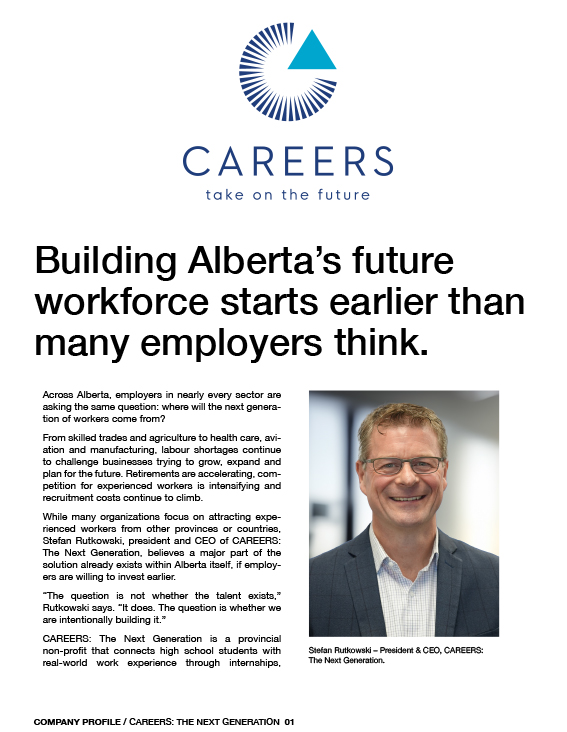
Across Alberta, employers in nearly every sector are asking the same question: where will the next generation of workers come from?
From skilled trades and agriculture to health care, aviation and manufacturing, labour shortages continue to challenge businesses trying to grow, expand and plan for the future. Retirements are accelerating, competition for experienced workers is intensifying and recruitment costs continue to climb.
While many organizations focus on attracting experienced workers from other provinces or countries, Stefan Rutkowski, president and CEO of CAREERS: The Next Generation, believes a major part of the solution already exists within Alberta itself, if employers are willing to invest earlier.
“The question is not whether the talent exists,” Rutkowski says. “It does. The question is whether we are intentionally building it.”
CAREERS: The Next Generation is a provincial non-profit that connects high school students with real-world work experience through internships, apprenticeships and other work-integrated learning opportunities. The organization partners with employers across Alberta to give students hands-on exposure to different industries while helping businesses build relationships with potential future employees.
Through these programs, students can explore career pathways before they graduate, while employers gain early insight into the next generation of talent entering the workforce.
For Rutkowski, the concept is straightforward: if employers want a stronger workforce tomorrow, they need to start developing it today.
Rethinking Workforce Strategy
For decades, workforce strategies across many industries have focused largely on recruitment. When labour shortages appear, companies advertise positions, offer incentives or compete to attract experienced workers from other organizations or regions.
Rutkowski acknowledges that recruitment will always play an important role in workforce planning. However, he argues that relying solely on attraction is becoming increasingly difficult and expensive.
“Workforce strategy has historically focused on attracting talent. This includes recruiting from other provinces, competing internationally or trying to hire experienced workers away from competitors,” he says. “Attraction will always be part of the equation, but it cannot be the only strategy.”
Instead, he believes more employers need to think about workforce development as a long-term investment that begins earlier in the talent pipeline.
“Sustainable workforce development requires us to participate earlier,” Rutkowski says. “The most resilient organizations I see today aren’t just hiring talent. They’re actively developing it.”
That development can take many forms: hosting internships, mentoring students, supporting apprenticeship pathways or building partnerships with schools and community organizations.
“These employers understand that investing early reduces their hiring risk later,” he adds.
The Business Case for Investing in Youth
When employers consider bringing high school students into their workplace through structured off-campus learning programs, the immediate reaction is often cautious. Questions about productivity, training time, safety and supervision are common.
Rutkowski understands those concerns well.
“I spent more than two decades working in industry before stepping into this role,” he says. “I’ve asked the same questions many employers ask today. Do we have time to mentor? Will productivity drop? What about safety or liability?”
He says employers who participate in youth workforce programs often discover significant benefits.
“When you bring a student into your workplace, you assess fit early,” Rutkowski explains. “Instead of relying only on interviews, you see how someone approaches work in real time, their attitude, their work ethic, their willingness to learn.”
That early exposure can help employers identify promising candidates long before traditional hiring processes begin.
Employers also have the opportunity to shape young workers’ skills and expectations from the beginning.
“You’re introducing them to your safety standards, your systems, your culture,” Rutkowski says. “You’re helping build the kind of employee you want to hire in the future.”
Another advantage is loyalty.
“Young people remember who gave them their first real opportunity,” he says. “That loyalty is genuine and lasting.”
According to Rutkowski, companies that actively develop youth talent often find it easier to attract strong applicants at every level.
“It strengthens your brand as an employer,” he says. “Organizations known for mentoring and developing young people tend to attract motivated candidates.”
Reducing Barriers for Employers
Programs like those offered by CAREERS are designed to make the process easier for employers who want to participate but may not know where to begin. Through CAREERS, students are matched with employers based on their interests, skills and career goals. The organization works closely with schools to coordinate placements and ensure students are prepared for the workplace.
Employers also receive support with program logistics, including coordination with off-campus educators and guidance on training requirements.
“Structured programs exist for a reason,” Rutkowski says. “They remove many of the barriers employers might worry about.”
For example, students participating in work-integrated learning placements typically receive safety training and are supported through their school’s off-campus education programs. For high school youth, Workers’ Compensation Board coverage is provided through the school system.
“You’re not navigating this alone,” Rutkowski says.
There are also financial supports available to help offset the cost of hiring and training young workers. Through programs such as the Youth Internship Incentive Program and the Alberta Youth Employment Incentive, employers may be eligible for wage subsidies of up to $7,500 when hiring eligible youth.
“These incentives are designed to reduce risk for employers while encouraging them to bring young people into their workforce,” Rutkowski says.
Despite these supports, he notes that some employers still hesitate, often because they underestimate the long-term cost of leaving positions unfilled.
“Every vacancy puts pressure on your existing team,” he says. “Every delayed succession plan increases operational risk. Every missed opportunity to develop local talent increases your reliance on external recruitment.”
Alberta’s Workforce Advantage
Rutkowski believes Alberta has a unique opportunity to lead in youth workforce development.
The province’s industries are diverse and closely connected to their communities, which creates an ideal environment for work-integrated learning.
“Alberta’s industries are entrepreneurial, practical and community-oriented,” he says. “That gives us a real advantage when it comes to building workforce pathways.”
When students gain exposure to real workplaces during high school, several positive outcomes follow. Students gain clarity about potential career paths in their communities. Families become more aware of in-demand occupations that they wouldn’t have considered otherwise. Schools are better able to connect classroom learning with real-world applications.
At the same time, employers begin building relationships with potential future workers.
“When employers open their doors to students, everyone benefits,” Rutkowski says. “Industry strengthens its talent pipeline and young people gain meaningful direction.”
In sectors such as construction, manufacturing, aviation and agriculture, these early experiences can also accelerate career development. Students who begin apprenticeship pathways while still in high school often complete their journeyperson certification years earlier than those who wait until after graduation.
“That acceleration matters,” Rutkowski says. “It means earlier productivity for employers and earlier career stability for young people.”
A Leadership Decision
Ultimately, Rutkowski believes youth workforce development is not simply an HR initiative. It is a leadership decision.
Organizations that actively develop young talent signal that they are planning for the future, investing in their communities and preparing for long-term workforce needs.
“The employers who will thrive in the next decade are the ones who treat workforce development as core strategy,” he says. “Not something that happens only when a vacancy appears.”
He believes Alberta’s business community has an opportunity to take a leading role in shaping the province’s labour market. If more employers committed to mentoring even a single student each year, the collective impact could be significant.
“I’m confident that if every Alberta employer with the capacity committed to mentoring even one student, the impact on our labour market would be transformative,” Rutkowski says.
A Call to Alberta Employers
As labour shortages continue to affect industries across the province, Rutkowski encourages employers to think differently about where their future workforce will come from. Instead of focusing only on recruitment, businesses can begin building stronger pipelines by engaging earlier with students who are exploring career options.
His challenge to employers is direct, “Look at your workforce plan. Look at your retirement projections. Look at your hardest to fill roles,” Rutkowski says. “Then ask yourself honestly: where are we intentionally building our next generation of talent?”
For many organizations, he believes the answer may lie closer than expected, in classrooms, schools and communities across Alberta.
“The next generation of Alberta’s workforce is ready to contribute,” Rutkowski says. “The question is whether we’re ready to invest in them.”