


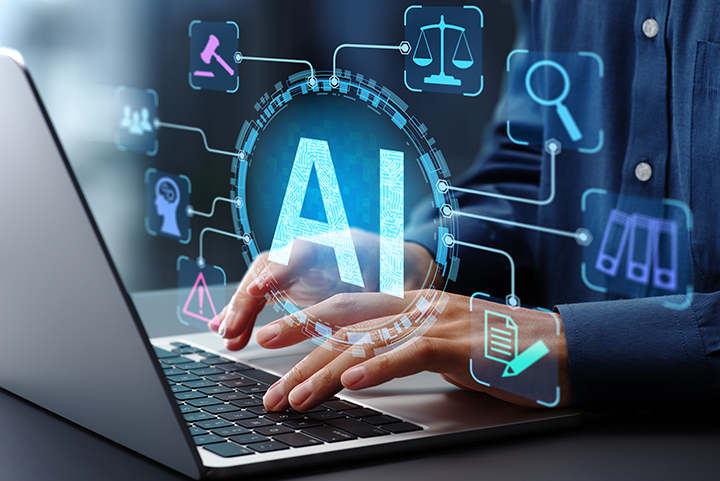
Technology in business is doing it again!
Some say AI is the second coming of software. Some praise and rave about AI as indispensable and making life easier and more efficient. Some are threatened, critical and warn about AI taking over, replacing humans and killing jobs.
There’s no doubt about it. AI’s vast capabilities are already reinventing how people access facts, details and information while definitely changing the nature of businesses and many jobs. It wasn’t that long ago that the concept was the stuff of science fiction, but the warp speed of technology, in life and business, has made AI a household name. Based on the McKinsey Global Survey on the State of AI in 2025, an estimated 88 per cent of organizations now use AI in at least one or more business functions.
Advocates enthusiastically make the misunderstood point that AI doesn’t reduce work—it intensifies it.
AI is a broad term that refers to computer software that engages in human-like activities, including learning, planning and problem solving. Calling specific applications “artificial intelligence” is like calling a car a “vehicle.” It’s technically correct, but leaves out important details.
For Edmonton businesses, the key uses involve generative AI, machine learning (ML) and deep learning, with particularly generative AI experiencing explosive growth in the past few years.
Edmonton tech experts, consultants and recruitment specialists, along with NAIT and MacEwan University, focus on the impact on local businesses and the skills and qualifications required for jobs.
AI is transforming business from a niche technical tool into foundational, enterprise-wide infrastructure, shifting focus from the usual cost cutting to strategic growth, innovation and enhanced productivity.
A key function is automation of routine tasks and operations, taking over repetitive, manual and administrative tasks, allowing employees to focus on higher value activities. Also, with accounting and finance roles, AI automates data entry, reconciles expenses and flags suspicious transactions for fraud detection in real time. For customer support, with 24/7 AI-powered chatbots handling basic inquiries and troubleshooting issues, AI significantly reduces response times. For recruitment, AI now screens resumes and matches candidates, speeding up the hiring process.
Generally, AI is enhancing business decision making and predictive analytics, analyzing datasets far beyond human capability to identify patterns, anomalies and insights that inform strategic business decisions.
AI is becoming essential for contemporary business, much like digital literacy has been over the past decade,” explains Tamara Peyton, dean of the School of Media and Information Technology at NAIT. “While many organizations are still in the experimentation or early adoption phase, the technology itself is mature enough to be deployed effectively. The greater challenge isn’t whether AI works, but whether organizations have the skills, governance and clarity to apply it effectively.
“As companies seek to improve efficiency, strengthen decision making and remain competitive, AI is increasingly viewed as a core capability—even as many continue to work through how to operationalize it responsibly.”
She notes that businesses are already adopting AI in very practical, everyday ways across the workplace. Employees are using AI powered tools to draft and summarize content, analyze data, support software development and assist with customer service.
Peyton also addresses the frequent accusation that AI is a job killer.
“In many cases, AI reduces repetitive, time‑consuming work and frees people’s time to focus on higher‑value tasks that require judgment, creativity and meaningful human interaction.”
According to Janine Hill, managing partner at Humanis Executive Search, “AI is changing how we work, collaborate and access information. It is already shaping how markets are analyzed, how data is processed and how insights are formed across leadership hiring.
“AI in business improves efficiency and clarity. It allows businesses to process information faster, identify patterns across talent markets and arrive at conversations better informed. As AI handles more routine or repeatable work, the human side of roles becomes more important.”
She adds that AI tends to move fastest in environments where large amounts of data are processed or where work involves repeatable tasks. Industries such as finance, marketing, technology and research are seeing significant acceleration because AI can support analysis, research and information processing.
Operations-heavy environments such as logistics and customer service are also seeing rapid change as automation improves efficiency.
Hill points out that organizations increasingly need people who can navigate complexity, exercise judgment, ask better questions and adapt to changing environments. In executive search, this includes things like accelerated market mapping, stronger insight into compensation and sector trends and better preparation ahead of client and candidate conversations.
Dr. Lisa Rochman, dean of MacEwan’s School of Continuing Education and Dr. Avi Sheshachalam, MacEwan’s senior business development officer in the School of Continuing Studies, are on the front line of AI in Edmonton businesses.
“AI is becoming increasingly important for business and will be crucial for remaining competitive in our evolving digital economy,” Rochman explains. “Companies are using AI to improve efficiency, make better use of data, personalize service, increase responsiveness, innovate, optimize processes and support faster, more informed decision making across their operations.”
Sheshachalam notes, “AI is critical for competitive advantage, but only when companies are disciplined about adoption. Real impact happens when businesses identify which repetitive operations can be automated, which ones need human oversight, and which operations have the processes in place to manage both. Without that discipline, AI adoption will not lead to expected return on investments.”
Peyton notes, “Just one example of how a sector can use AI is healthcare. Doctors and clinicians have traditionally spent a significant portion of their time on documentation, which is time away from their core function of helping patients. Today, many clinicians are using AI‑powered medical scribes to capture notes during patient visits, significantly reducing administrative burden.”
Carson Integrated, Alberta’s experts in ecosystem, environmental, forestry and GIS consulting services across Western Canada, is an excellent example of how adapting to AI is a crucial aspect of contemporary business.
“We are already seeing AI operate as a working partner within teams in some places,” says president Lorne Carson. “This will continue to grow. People will need to learn how to work alongside AI tools. It makes human skills more important, not less. Durable skills such as critical thinking, communication, creativity, judgment and collaboration remain essential because AI tools still require human oversight, context and decision making.”
He recommends that people should take training, such as those offered through Amii (the Alberta Machine Intelligence Institute), then start dabbling. Try using AI to help solve a few problems or to streamline a few processes and then go from there.
Carson disagrees with the thought that AI will steal jobs.
“On the contrary, AI will help to make us more competitive and allow our company to continue to grow and create additional jobs.”
The experts are unanimous. Businesses have no choice when it comes to AI.
“Pandora’s box is open. We can’t prevent AI tools from entering workplaces because they’re already here,” says Sheshachalam.
Rochman emphasizes that, like other prior technological shifts, AI will change the nature of many roles that exist today and automate certain tasks. Some roles that currently exist will no longer be needed, but new roles will be created.
“I don’t think AI is replacing humans, but reshaping how work is done and creating more space for people to focus on higher-value activities.”