


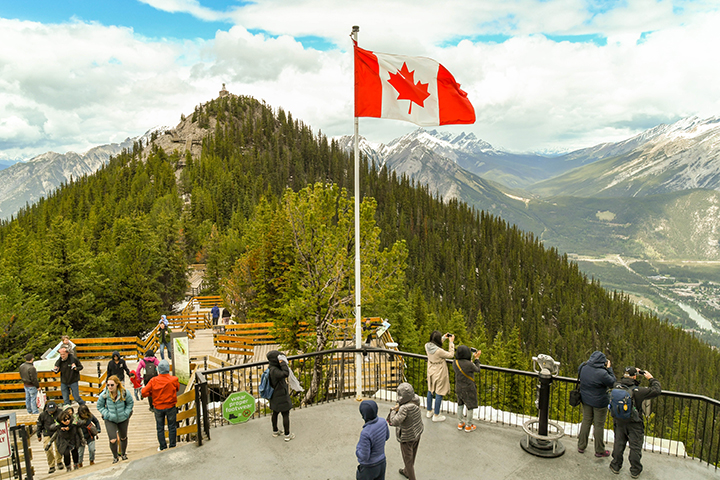
Despite some unpredictable and unexpected flux, and the strategy that it’s ok for the province to brag without jinxing itself, Alberta tourism is experiencing record-breaking growth! Visitor spending reached $15.2 billion in 2025, a 6 per cent year-over-year increase.
The growth is driven by Alberta’s popularity with visitors from across Canada, and high international interest particularly from the US, Mexico, South Korea and Japan. Edmonton’s staycation trend is also a positive factor. Most tourism spending in the region now comes from domestic travelers, rather than international visitors.
According to Stavros Karlos, director of Research, Policy & Government Affairs with the Tourism Industry Association of Alberta (TIAA), “The breakdown of visitor origins shows that Alberta is heavily reliant on domestic travelers, who made up roughly 93 per cent of all visitors in 2025. Out of an estimated 37.8 million total visitors, approximately 82 per cent were Albertans traveling within their own province.
“Visitors from the rest of Canada accounted for about 11 per cent (4.2 million people), while international visitors represented the remaining 7 per cent. The international segment comprised roughly 1.5 million visitors from the United States and 1.2 million from overseas.”
Another reason is the rise of home-based travel agents, having moved away from traditional brick-and-mortar locations to home-based models, with higher earnings.
For Alberta, and particularly for Edmonton, Karlos adds the important tourism-as-a-business detail that out of province and out of country travelers are the highest spending visitors and bring in valuable foreign exchange.
Tourism is important business, supporting more than 86,000 full-time Alberta jobs and accounting for a large portion of the provincial workforce.
Provincial stats and trending show the big Alberta tourism draws are iconic Rocky Mountain landscapes, national parks, vibrant cities and popular provincial attractions like Rogers Place, conventions and conferences, West Edmonton Mall (which has the world’s largest indoor wave pool and amusement park), Banff and Jasper National Parks, Lake Louise, the Calgary Stampede and more.
“Specifically in the Edmonton region, tourism is strong,” says Emma Pietroleonardo, the general manager of the Edmonton Convention Centre and Explore Edmonton. “The numbers show that our city is busy and economically significant.
“The Edmonton region attracts about 6.5 -7 million visitors per year, spending more than $2.5 billion. We’re proud of that! It represents 18 per cent of Alberta’s total tourism spending and 2.2 per cent of Canada’s total tourism spending.”
Edmonton’s tourism bragging rights include the recognition of being “a must-visit city” by Lonely Planet, boosting global Edmonton awareness.
“We are also currently the #1 sports city in Canada and #22 in the world,” she adds with enthusiasm, “as we are home to the largest stadium in Canada (Commonwealth Stadium) and Rogers Place, one of the most iconic world class sports stadiums; and, of course, West Edmonton Mall is one of the largest malls in the world and also a major tourism driver.”
She also highlights ICE District, Elk Island National Park, Edmonton Valley Zoo, Fort Edmonton Park, Royal Alberta Museum, Muttart Conservatory, Telus World of Science and the many festivals and cultural events.
“The international Fringe Theatre Festival, with over 750,000 site visits and 127,000 ticketed attendees, makes it the second largest Fringe Festival in the world. Taste of Edmonton sees more than 210,000 visitors annually. Taste of Edmonton has more than 210,000 visitors every year. Last year’s Canadian Finals Rodeo drew 42,000 attendees and generated $32 million in economic impact and won a destination of the year award.”
Conventions, trade shows and conferences are also vital components of Edmonton tourism.
As Pietroleonardo points out, Edmonton’s convention and conference sector continues to grow. In 2025, Edmonton hosted 75 business events that generated more than $81 million in economic impact.
Edmonton Convention Centre stands out as a major international meeting hotspot, having hosted around 330 events and welcoming over 260,000 attendees. Edmonton Convention Centre alone produced $265 million in economic impact from meetings, conventions and events.
Edmonton is attracting high profile sector conferences, especially in innovation, science and Indigenous tourism. IITC 2026 is the largest Indigenous Tourism Conference in the country and was held at the Edmonton Convention Centre. The Upper Bound AI Conference hosted 5,500 delegates from 25 countries and nearly 1,000 organizations, highlighting Edmonton as a global AI hub.
“We are often recognized on the national and international stages as being a powerhouse in the meetings and events industry space,” says Pietroleonardo.
There is another expected tourism trend. Travel agents are back!
According to StatsCan, there is an uptick in demand for travel professionals, driven by complex post-COVID travel; unexpected and disappointments with online-booked and no-recourse trip problems; a demand for customized, secure, and stress-free planning and the trend of more and more Canadians turning to professionals to manage bucket lists and complex trips.
As with many other business sectors, there has been a shift in terminology, with a growing preference for the term “travel advisor” or “travel consultant,” reflecting a shift from simple booking to a professional, personalized and reliable service.
A major broadside for Alberta tourism – and the 800-pound elephant in the room – is the impact of the U.S. backlash, driven by trade disputes and “51st State” political tensions since 2025. Ironically, it continues to only boost Alberta’s tourism.
As Albertans pivot to local travel, the province experienced a 5 per cent increase in American visitors, contrary to a 6 per cent decline in U.S. traffic nationwide, outperforming other provinces, particularly due to strong interest from key markets like California and Texas.
The breakdown of visitor origins shows that Alberta is heavily reliant on domestic travelers, who made up roughly 93 per cent of all visitors in 2025. It also means a significant uptick in local spending. Approximately 30 per cent of Albertans cancelled U.S. travel plans, choosing to travel within the province, boosting local, regional and national tourism.
Pietroleonardo says, “Domestic spending increased by 17 percent year-over-year. Domestic visits increased by 4 per cent. Albertans accounted for 71 per cent of spending in the region. The average spend per person (overnight visit) was $670.”
As for the business of tourism for the rest of this year?
“TIAA projects a moderate growth rate of about 3 per cent,” Stavros Karlos estimates. “While international markets are expected to show the strongest growth, we warn of waning momentum due to global economic uncertainty, high fuel and other travel costs and lingering trade tensions.”
TIAA emphasizes that Alberta may be hitting a growth ceiling, suggesting that the focus for 2026 must be to rapidly attract and drive both private and public investment into infrastructure such as hotels and modern year-round outdoor experiences, to accommodate a growing population and maintain our competitive edge internationally.