


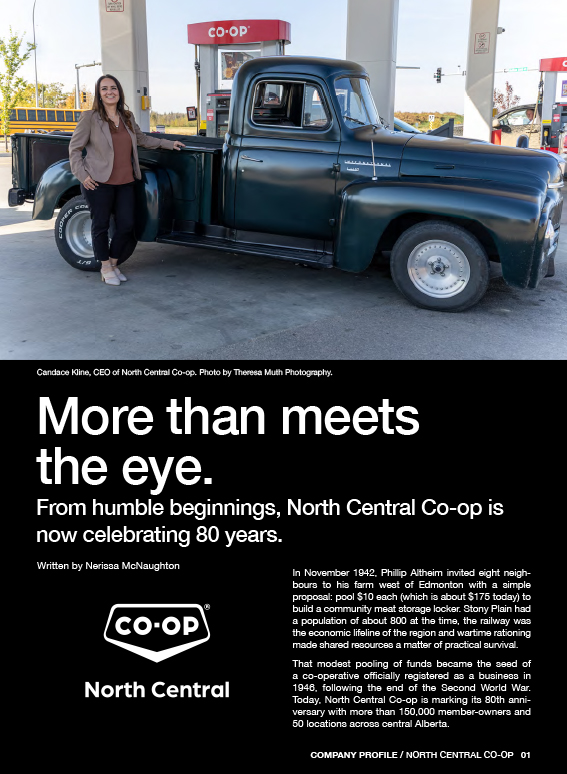
In November 1942, Phillip Altheim invited eight neighbours to his farm west of Edmonton with a simple proposal: pool $10 each (which is about $175 today) to build a community meat storage locker. Stony Plain had a population of about 800 at the time, the railway was the economic lifeline of the region and wartime rationing made shared resources a matter of practical survival.
That modest pooling of funds became the seed of a co-operative officially registered as a business in 1946, following the end of the Second World War. Today, North Central Co-op is marking its 80th anniversary with more than 150,000 member-owners and 50 locations across central Alberta.
“They got together to construct a cold meat storage locker, and it just built from there,” says Candace Kline, CEO of North Central Co-op, who has been with the organization for just over nine years after stepping into the CEO role in May. Kline goes on to say that those farmers started a business that now employs about 700 team members.
The organization’s footprint and identity have shifted considerably since the 1940s. For decades it operated as Stony Plain Co-op, a name tied to its founding community. As the business expanded into Edmonton, St. Albert, Fort Saskatchewan, Spruce Grove and beyond, that name stopped reflecting the scope of the operation. The rebrand to North Central Co-op took effect around 2014.
Kline explains, “We needed to have a name that signified the whole territory, not just one specific place.”
Even with a name that better fits its reach, North Central Co-op is still headquartered in Stony Plain, a detail Kline says most people do not realize. Part of the confusion comes from how the broader co-operative retailing system works. North Central is one of roughly 148 independent retail co-operatives operating under the Co-op banner across Western Canada.
“It can be a bit challenging to understand,” she shares. “We’re all under the Co-op umbrella, but we’re independent too, so the memberships work for the areas for which they’re issued.”
The growth curve tells its own story. In 2005, North Central operated four locations with 75 team members. By 2015, that had grown to 17 locations, nearly 300 employees and about 57,000 member-owners. Today, in 2026, Co-op member numbers top 150,000.
Kline admits that the trajectory has not been without setbacks.
“As we celebrate our 80th anniversary, we recognize that our history includes both successes and challenges. From the economic pressures of the 1980s to the energy crisis and the COVID-19 pandemic, we’ve navigated difficult times together. Through it all, our commitment has remained constant: to be here for our member-owners and support the communities we serve.”
What sets North Central Co-op apart from national grocery and fuel competitors is structural rather than promotional. It is a member-owned co-operative, which means profits generated by the business flow back to the people who shop there rather than to outside shareholders.
“We are truly Canadian.” Kline adds. “We don’t have a corporate office somewhere else. The people making the decisions live and work here.”
Since 2020, that commitment has translated into $9.8 million returned to member-owners through cash back and equity payments, on top of everyday savings from shopping at Co-op locations. Member-owners buy shares in the organization, giving them a direct ownership stake. When the retail turns a profit, members receive a share of that profit, either as a cash payout or as a deposit into an individual equity account that functions much like a savings account.
The equity can be withdrawn when a member turns 65, moves away or passes on. Kline recalls one member who withdrew an unexpected $15,000 in accumulated equity and used it to take her daughter on a trip to Italy.
“A membership is investing in your community and it’s future” Kline says. “When you shop at your local Co-op, your community and neighbours benefit.”
Governance also runs through the membership. Nine directors, elected by member-owners at the annual general meeting for three-year terms, oversee the organization, with three or four seats up for election each year. Competition for those seats has grown alongside membership awareness; last year’s election drew 14 candidates for four open positions.
Giving back is a call to the roots of the organization, and a value that has never wavered in eight decades of service. For the little ones, North Central Co-op runs a Co-op Kids Club, donates all the candy for Boo at the Zoo and hosts seasonal activities such as pumpkin carving and cookie decorating at its food stores, aiming to introduce the co-operative model to a generation that will eventually choose where to shop and bank their loyalty.
“Those are our future shoppers. Those are our future member-owners that we want to engage with now,” Kline says.
Community investment extends well beyond member-owner perks. North Central Co-op allocates more than $300,000 annually into local initiatives across youth education, youth sports and recreation, community growth, health and wellness and the environment, a figure that does not account for the volunteer hours its team members contribute.
Recent commitments include their Next 80 Community Impact Grant that provided $50,000 to a community project in October in support of the Zebra Centre, more than $100,000 raised in a single year through its Good Buy to Hunger campaign, support for school breakfast and lunch programs and a title sponsorship of KDays.
When asked what the founders would make of the organization today, Kline does not hesitate.
“I think they would certainly be proud. After eight decades, we still live by the same co-operative spirit. I think they would be amazed by how they’ve gone from eight individuals getting together to support each other to 150,000 member-owners. This milestone anniversary is clear proof that they were on the right track all those years ago.”
Eighty years after a farmhouse meeting, North Central Co-op has grown into one of the largest locally owned businesses in the region, still governed by its member-owners and still reinvesting in the communities it serves. For Kline, the anniversary is less about looking back and much more about the path forward.
“We’re a different kind of business. We’re still here and we’re still relevant,” she concludes. “We intend to stay that way.”