


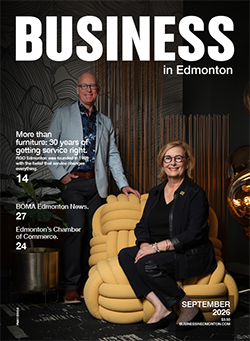
Ken Barry was 34 years old when he and his wife, Magdalena, loaded up their family and left Ontario for Alberta. He had a background in commercial furniture with one of the world’s largest office furniture manufacturers, and he had spotted something most people hadn’t yet: Edmonton needed a better office interiors dealership. The timing was right.
“I partnered with Ross Glen (RGO Calgary) when we realized there was an opportunity to open a new distributor and dealership here in Edmonton,” says Barry, president and founder of RGO Edmonton. “From our inception, we always maintained — and tried to impress upon our team — that what we provide is really a combination of three things: service, knowledge and great products.”
That was 1996. Thirty years later, RGO Edmonton has grown into a team of 60 people serving clients across northern Alberta, with a reach that stretches from Edmonton to Fort McMurray, Grande Prairie and beyond. The business has expanded well past its roots to include commercial window coverings, office technology and a suite of workplace services, including design.
To understand RGO Edmonton, it helps to first understand RGO Calgary — and the man who built it.
Ross Glen founded RGO in Calgary in 1966 with just three people in a small office. Over the decades, Glen grew the company into the largest dealership of its kind in western Canada, guided by a belief that a true one-stop shop could outperform any specialist competitor. In 2016, he was inducted into the Calgary Business Hall of Fame. In 2020, he was appointed to the Order of Canada.
When Barry arrived in Edmonton and partnered with Glen and Glen’s daughter Cathy Orr — now president and CEO of RGO Calgary & Canmore — to establish the Edmonton location, he built on both a brand name and a philosophy.
“Ross and I always felt it was about service,” Barry says, “service to our clients, our business partners and our vendors. However, perhaps the biggest piece is service to each other internally because that’s what our clients are going to notice – how effective we are as an organization working together.”
When asked what makes RGO competitive, he gives you an answer that is less about product lines and more about intellectual investment.
“The easy one is to say the exclusivity we have with some of the products we represent,” he admits, “but more importantly than that, I think it’s the time and attention and effort we put into understanding work, understanding the workplace and being able to continuously bring greater value, greater knowledge and greater insights to the audiences with whom we engage.”
“We have access to, and spend a lot of time understanding, the trends and the insights,” he continues. “It’s about knowing where work and the workplace are headed, and then asking: how do we make sure our clients are anticipating that and are going to be able to take advantage of it?”
If you think RGO Edmonton sells furniture, you’re only partly right — and that misconception is something Barry has been correcting for years.
“I always think we’re certainly more than furniture,” he says with a laugh. “A lot of people don’t appreciate the diversity in what we offer. In Edmonton, we provide commercial window coverings as a very significant portion of what we do. We also provide office technology products and all of the services that go along with those different divisions: install, service after the fact, repair, maintenance. It’s much more than just furniture.”
There’s also a myth about the warehouse.
“A lot of people think we have a warehouse full of furniture they can just draw on,” he says. “I would say 99 per cent of our business is custom ordered product to the customer’s specifications and finishes. We don’t really carry stock inventory. What is in the warehouse is mostly items our customers have ordered.”
Barry is proud of the team that has been tracking the evolution of the workplace for decades.
In the 1990s, the big driver was technology. The size of computers, the spread of monitors and the arrival of laptops all shaped how offices were laid out. Then came the paperless push. Storage walls and filing cabinets gave way to open collaboration zones. Then COVID arrived and scrambled everything.
“Going through COVID, we had a resurgence in private spaces so that people could be separate and engaged in the virtual world,” Barry explains, “but people also wanted shared, communal spaces where they could work more collaboratively in a comfortable, almost non-traditional way.”
That shift was towards what the industry calls ancillary product. The sofas, soft seating, lounge chairs and café-style seating all reflect a broader truth Barry believes: your office has to earn the commute.
“You have to earn the commute with your staff now,” he affirms, “because there has to be a compelling reason why they would choose to come to the workplace.”
In that light, one of the most used spaces RGO designs today are workplace cafés.
“At its core it’s supposed to be a place for folks to have a meal at lunchtime,” Barry says. “Yet, now it’s a more comfortable, inviting place where people will meet and collaborate throughout the day. It’s used because it feels good. Fifteen years ago, that would have been quite a novel concept.”
Over and above the office café, Barry doesn’t have trouble listing completed projects. He has trouble narrowing them down. For example, healthcare has become a significant focus for RGO Edmonton in recent years. The demands are different from a typical office since the spaces are more holistic and the requirements more complex. However, the impact is immediate and tangible.
“There’s a lot of improvement that can happen, and improvement that’s desired, for the delivery of healthcare right across the country,” Barry says. “We’re very proud of the work we’ve done with Alberta Health Services, Covenant House and various private clinics.”
Higher education is another area of growth. The new School of Business at MacEwan University is a project Barry mentions with pride.
“It’s a beautiful new space,” he smiles. “It’s a great anchor and a great destination for people to go downtown.”
Yet, the project that seems to sit closest to his heart at the moment is King Thunderbird, a community facility in Edmonton that provides services to inner-city residents.
“They’ve got a number of different mandates in there, including some public care applications,” Barry says. “It’s a respite for folks and a place to provide services to our inner-city community. It’s a beautiful new space, done in a very personalized way. It is professional, but also sensitive to the audience. It’s a huge step up from how services have been delivered in the past, and we were very proud to be part of it.”
That pride in community impact runs through everything Barry talks about when the subject of giving back comes up. From day one, United Way has been RGO Edmonton’s anchor charity.
“I realized United Way had the broadest reach and the highest percentage of your dollar going directly to programs. We’ve had a campaign every year since our inception and we’re pretty close to having raised over half a million dollars internally, which is pretty awesome!”
Mental Health Foundation, disabilities support through Chrysalis and a longstanding commitment to post-secondary education round out a giving portfolio that Barry says reflects his own values as much as RGO’s brand.
“Ross and I both believe in higher education and fostering an environment where the next generation has those opportunities,” he notes. “I’ve always felt pretty good about the impact that can have.”
Barry started this business at 34 with, by his own admission, very little management experience.
“I had very little experience managing people at all, let alone running a business,” he says. “I hope I can say comfortably that I’ve grown into the role.”
His leadership style has shifted considerably over three decades. Early on, he felt the pressure to have all the answers. Now he knows better.
“I don’t need to have all the answers all the time,” he says. “I would say I’m certainly more collaborative now, more supportive, asking a lot more questions. A big part of what I do is create an environment where our leaders can learn, thrive and grow. That’s a long way from what I thought leadership was when I was in my 30s.”
That philosophy is reflected in RGO Edmonton’s Great Place to Work certification, which it has earned for 5 years, and counting.
“It’s an acknowledgement from the folks who actually work here that we’re doing something right,” Barry says. “We don’t always get it perfect. It’s a work in progress, but I think people are proud to be part of the organization. They feel part of a team. That designation is a commitment — from us to the organization, and from our staff to the organization — to keep getting better.”
At 30 years in, Barry is not slowing down. He talks about the future with the same forward-leaning energy he must have had when he first drove into Edmonton with his family and a plan.
Healthcare, higher education, AI-driven workplace adaptation — he sees opportunity in all of it.
“I think what’s happening with AI is going to do two things,” he says. “It will allow us to work better and smarter internally. However, it’s also going to create new requirements and new opportunities in how organizations incorporate that into their physical space.”
Yet, he notes the pendulum always swings.
“There’s always been a need for spaces and environments that support the human part of our business,” he says. “People still need to convene and interact. I’ve heard it called ‘tech recessive or tech free space’ because people are getting a little overwhelmed by how much technology is out there and how much time and energy it consumes. So, some of that will change the equation going forward.”
What does not change, after 30 years, is the foundation: Service. Knowledge. Products.
“Your physical space matters,” Barry concludes. “It’s a lever to reach and leverage the largest investment you’re making, which is typically your people. Just about every business would have to admit their largest single expense line is staffing. So, it’s in every organization’s best interest to leverage their space — to make it more desirable to be there, more comfortable to work and more optimal from an efficiency and effectiveness standpoint.”
Thirty years ago, a 34-year-old from Ontario said almost exactly the same thing to his first clients in Edmonton. Some things, it turns out, don’t change at all.