


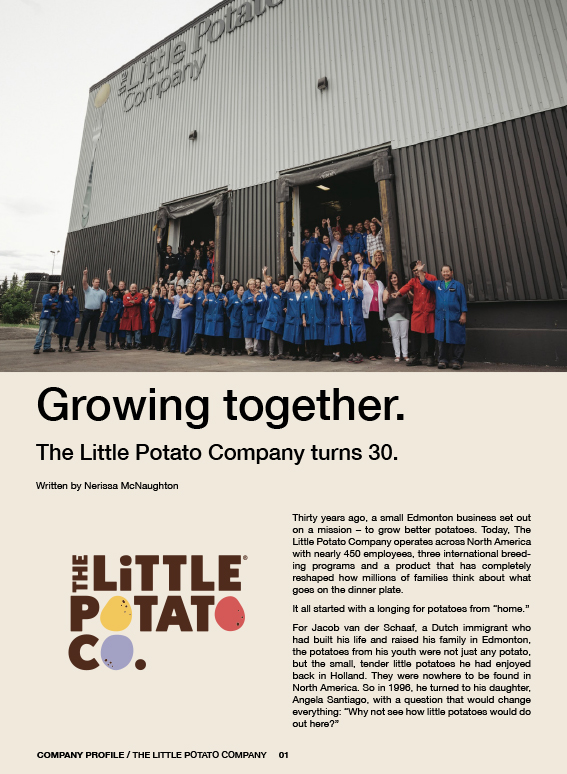
Thirty years ago, a small Edmonton business set out on a mission – to grow better potatoes. Today, The Little Potato Company operates across North America with nearly 450 employees, three international breeding programs and a product that has completely reshaped how millions of families think about what goes on the dinner plate.
It all started with a longing for potatoes from “home.”
For Jacob van der Schaaf, a Dutch immigrant who had built his life and raised his family in Edmonton, the potatoes from his youth were not just any potato, but the small, tender little potatoes he had enjoyed back in Holland. They were nowhere to be found in North America. So in 1996, he turned to his daughter, Angela Santiago, with a question that would change everything: “Why not see how little potatoes would do out here?”
At the time, Santiago was 24, freshly graduated from the University of Alberta with a business degree and an open path forward. She agreed to help her father, never imagining she would still be there decades later.
“I fell in love with potatoes and I fell in love with food,” she says, “but I fell in love with the purpose of the company, and that was to ‘Feed the World, Better.’”
Before The Little Potato Company existed, the small potatoes clinging to the roots of a mature plant were dismissed as “the cull,” off-grade scraps left behind in the field. Van der Schaaf and Santiago saw something different. Through extensive R&D, they turned those overlooked spuds into a nutritious product that now puts an easy, convenient, healthy, whole food on thousands of plates.
These are not baby potatoes; that is a common misconception. They are mature potatoes, bred and cultivated specifically to stay small. The distinction matters a lot to the company, and it starts long before a seed goes into the ground. The Little Potato Company operates three breeding programs – one in Canada, one in Chile and one in the Netherlands – which, together, form the largest little potato breeding program in the world.
From humble beginnings to 30 years later, Santiago, CEO, has helped to guide the company from its local roots here in Edmonton to retail shelves across Canada, the United States and now, Mexico.
The past five years alone have brought a wave of expansion. Growth in the Canadian market accelerated, the United States market became stronger for the brand and the company entered Mexico. On the production side, a new facility in Nisku was completed – a significant capital investment that reflects the company’s commitment to its home province.
“That new facility was a big deal for us,” Santiago says. “It’s a sign of where we’ve come from and where we’re going.”
Santiago continues, “The power has always been in our integrated value chain. We start with our breeding program, then our agronomy team works with growers on everything from soil selection to spacing and fertilizer. These potatoes are carefully bred for quality and consistency and then grown using those same high standards in collaboration with our family farmers across North America.”
That value of partnership also drove the company’s Grower’s Field Day, a large-scale event that brought together growers, breeders, field teams and company leadership from across the continent every two to three years. Paused during the COVID-19 pandemic, it is now slated for revival.
“It was our chance to spend time together, share best practices, hear how growing in Wisconsin compares to growing in Alberta, etc.” Santiago says, “For us as an executive team, it was our opportunity to sit with the growers and share the vision of where the company is heading. It really showed the power of being vertically integrated.”
Product innovation has followed the same logic of making good things easier for busy families. About a decade ago, Santiago and her team spotted a microwave-ready vegetable format at a trade show – one being used primarily with large potatoes and other vegetables. They recognized immediately that the concept was a natural fit for little potatoes.
“We thought it lent itself even better to being little,” she recalls. The result is a skin-on, flavour-seasoned product that cooks in five minutes. “It still honours what a little potato is. We give people a vehicle to get a healthy, great-tasting potato on the table fast.”
Convenience, however, is only part of the company’s story. Sustainability has been a part of the operations from early on. This is a natural extension, Santiago says, of working so closely with the land.
For example, the Nisku facility featured one of the largest private solar installations in Western Canada at the time it was built. The facilities operate water recycling systems. Packaging has been progressively reduced. Agronomic work with growers continually focuses on improving crop quality while using land, water and other resources as efficiently and responsibly as possible.
“When your product comes from the land, you are always thinking about how to leave things better for the next generation,” Santiago says. “Sustainability comes in many forms. It’s all in the essence of doing things better and leading better.”
Community giving is equally fundamental. The company donates to food banks in both Canada and the United States, a commitment that Santiago ties directly to The Little Potato Company’s stated purpose: “Feed the World, Better.”
“Our values of people, product and purpose are not just people who can afford our product,” she says. “It’s also people who can’t. That’s how we live our purpose in a very real way, outside of what you see in a retail store.”
Leading an organization of this scale – about 270 employees in Canada and 180 in the United States – requires constant evolution, and Santiago is candid about the challenges that come with growth. Communication has become one of the more complex ones.
“I used to be able to get most of our employees in a room together. That’s not possible now,” she says. “The challenge is continually adapting my leadership style so that people continue to feel like they’re part of the journey.”
She also speaks openly about the discipline required to keep her attention on the horizon rather than on the day-to-day. “I have to keep asking myself: where do I want to be in five years? In 10? That applies to our breeding program, marketing, where we want to sell and so much more.”
Her leadership style, shaped over three decades, is rooted in empowerment. She resists micromanaging and actively cultivates an environment where people can grow, experiment, make decisions and take ownership of their work.
“I look at people holistically,” she says. “We all come to work as a whole person. We can’t park everything at the door. So, I try to ask not just what someone brings to the company, but whether they’re happy as a person.”
The rewards, for her, are personal as much as professional.
“I love seeing people grow in their skillset, watching someone face a challenge and rise to it. I still get a thrill when I see someone put our potatoes in their cart. That’s why a lot of us get up in the morning.”
Founded in Alberta with a widening global reach, Santiago remains proud of the company’s roots and the entrepreneurial culture that has supported The Little Potato Company from the start.
“Thirty years later, Alberta continues to foster entrepreneurship and new ideas, and that support has been an important part of our journey,” she adds.
The phrase “growing together” is more than a company mission. It is, Santiago says, both a management philosophy and a declaration of values. No single part of the business – supply, operations, marketing, sales – succeeds in isolation and no individual is measured apart from the team around them.
Three decades in, the little potatoes that started it all are still at the heart of everything. They are bred carefully, grown responsibly, shipped to families across the continent and, in no small measure, donated to those who need them most. That is a successful confluence of people, passion, purpose – and potatoes.