


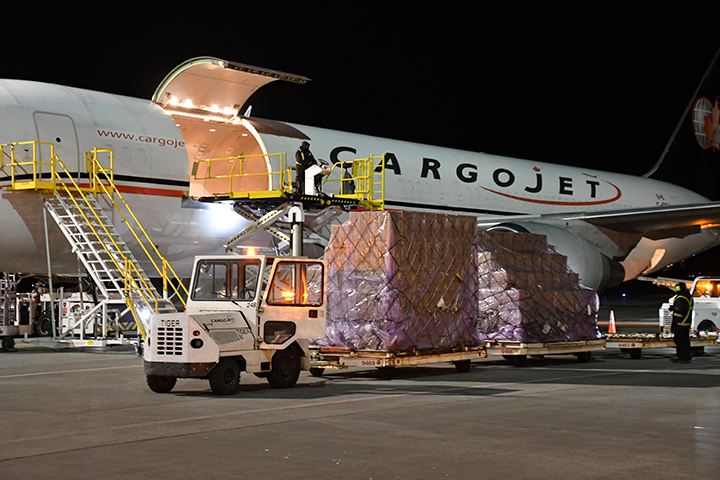
The focus and tremendous success of YEG’s Cargo Village is boosting Edmonton’s rank and reputation as a North American logistics hub – but it wasn’t easy.
Driven by its strategic location at the intersection of major rail, road and air cargo routes, vitally important infrastructure like the airport, and supported by a $120+ billion regional GDP, low business costs and integration with specialized, intermodal and technology-driven, sustainable, data-based solutions—Cargo Village is dynamic.
It is globally recognized as a potent multimodal hub, connecting to both Canadian coasts, the U.S. Midwest and the Gulf Coast via rail and highway. Acknowledged as a gateway to Northern Canada and as a critical node in Western Canada’s supply chain, Edmonton’s Cargo Village at YEG continues to expand its capabilities, while strongly linked to Alberta’s oil, gas and manufacturing sectors, and moving toward greater automation and data analytics to mitigate labour shortages.
Daryn Edgar, CEO of Edmonton Global – the foreign direct investment (FDI) and international business development agency focused on making the Edmonton region the choice location for global investment and representing 14 municipalities in the Edmonton region—emphasizes that logistics are crucial for the region’s economy and development.
“Edmonton’s logistics strength is built on a combination of geography, infrastructure and scale, and cargo and logistics are a significant and enabling driver of the Edmonton region’s economy. It supports trade, industrial development and long‑term diversification.
“At a provincial level, transportation and warehousing generated $32.8 billion in GDP in Alberta,” she says, “and this is growing 8.9 per cent, year‑over‑year—well above the overall Canadian economic growth rate of 1.6 per cent. It underscores the sector’s strength and momentum relative to the broader economy.”
Facts and figures show that, at the regional level, transportation and logistics account for approximately 3.9 per cent of the GDP and 3.7 per cent of employment in the Edmonton region.
“Importantly, logistics functions as economic infrastructure. It lowers costs, improves speed to market and increases resilience for exporters and manufacturers.”
Edgar is enthusiastic that it has helped position the Edmonton region as a competitive inland hub for companies serving both North American and global markets.
“Our cargo operations are a critical engine for economic growth, trade and supply chain resilience across Alberta and beyond,” says Alex Lowe, director, e-Commerce, Cargo and Aviation Real Estate at Edmonton International Airport (YEG). “By connecting regional businesses to national and global markets, Cargo Village supports exports, attracts investment and strengthens the region’s position as a logistics gateway.
“Last year, YEG continued to invest in infrastructure, partnerships and innovation to expand cargo capacity and unlock new opportunities for businesses of all sizes. The total estimated economic output value of commodities and products exported at YEG in 2024 (the most current available data) is close to US$350 million.”
He notes the major exports were parts and components for power, agriculture, construction, mining and handling (17 per cent); semiconductors (12 per cent); and parts and components of other machinery, including household machinery (10 per cent).
It’s not that there haven’t been speed bumps.
Lowe points out that, in the past five years, the industry has weathered supply chain disruptions due to the pandemic and more recently, the economic impact of tariffs.
“These disruptions have shown the value of secure supply chains and logistics infrastructure. Cargo shipments in Canada are experiencing notable pressure on costs due to high fuel prices and the impact of trade tariffs. The combined impact of a volatile geopolitical environment, increasing oil prices and U.S. tariffs on many Canadian imports has created a high-cost environment for shippers, carriers and consumers.”
He explains that rising oil prices (exacerbated by instability in the Middle East) directly translate to higher fuel costs, which make it more expensive to fuel planes. Since YEG exports a high quantity of energy equipment and products, when energy prices spike, the demand also grows, increasing cargo through YEG.
Some of Cargo Village’s growth and success are acknowledged, while some are subtle and lesser known.
YEG offers a revenue-generating and low-cost freighter gateway for cargo flights. Edmonton is Canada’s largest airport by land mass, and the fifth largest airport by passenger volume, with over $1.5 billion in on-airport development and $300M+ in newly announced cargo development, as well as the $36M cargo expansion, which is nearing completion.
“In addition to YEG’s land availability, our region also has a variety of low-cost shovel ready sites, perfect for manufacturers or storage and delivery needs,” Lowe adds. “YEG has 24/7/365 uncongested operations with no curfews or operating restrictions, as well as low landing and operating costs and, despite recent gas price hikes and fluctuations, competitive fuel prices.”
YEG has two-way cargo demand to support cargo freighters, belly cargo opportunity for passenger flights and the region has efficient and economical onward logistics. It is within minutes of Nisku Industrial Park, has direct access to the CANAMEX corridor to the US and Mexico and two intermodal rail yards that provide inland and marine container service.
Edmonton is the first airport in Canada to launch a scheduled commercial drone cargo delivery route within controlled airspace. Phase two of YEG’s commercial drone delivery program flew a total of 4,230 kilometres and reached several milestones in 2025, transitioning into scheduled weekday service with set departure and arrival times.
The program is safely operated in controlled airspace, carrying time-critical and temperature-sensitive cargo, including over-the-counter medical products. It is the first drone program in Canada to safely intersect with an active runway glide path.
Edgar emphasises that technology is now a critical aspect of the global logistics sector, and an increasingly important differentiator for Edmonton’s logistics ecosystem.
“AI‑enabled supply chain optimization, automation and intelligent transportation systems are already improving efficiency and resilience across warehousing, freight movement and inventory management. Technologies support faster decision making and more reliable logistics performance. Emerging applications, such as drones, are being explored for specialized use cases, including last‑mile delivery, industrial inspection and servicing remote or time sensitive supply chains.”
While still an evolving area, Edmonton’s airspace, research capacity and innovation ecosystem position the region as a strong testbed for next generation logistics solutions.
Lowe underscores that Edmonton’s geographic positioning enables efficient transpacific, transatlantic and circumpolar routing. As Canada’s northernmost major international airport, we are a practical logistics gateway to the North.
“YEG is capitalizing on this opportunity through investments like our International Cargo Hub, the most ambitious cargo expansion in the airport’s history. The $300M project has received a $160M contribution from the Government of Canada through the National Trade Corridors Fund.”
He adds that Cargo Village is making investments that will help Edmonton succeed in what is an uncertain and shifting logistics landscape.
Last year, construction began for YEG’s International Cargo Hub (ICH), a transformational development designed to expand cargo operations and support long-term economic growth. Once complete, the ICH will unlock 2,000 acres of land, delivering critical transportation capacity, creating job opportunities and enabling YEG to meet growing demand for air cargo and logistics services. Completion of Phase 1 is targeted for 2027.
“The Government of Canada’s investment in the ICH at Edmonton airport is a validation of the potential for this project to transform and enhance the movement of goods in and out of Canada and streamline supply chains.”