


A blank sheet of paper carries a certain weight when a family’s future home rests on it. Every line drawn represents a decision about how people will live, gather and grow for decades to come. For 20 years, BOSS Design has taken on that responsibility, transforming ideas into award-winning custom homes across Canada. The firm’s story is one of calculated risk, disciplined growth and a single guiding principle that its founder returns to again and again: be bold.
Founded in January 2006 by president Jeremy Walter, BOSS Design has become one of the region’s most respected architectural technology and interior design practices. Today, the company is led alongside partner and VP of design Brett Johnson and special projects lead Amanda Walter.
The decision to strike out alone came from a restlessness Jeremy could no longer ignore. He had reached a turning point in his career, convinced that working under someone else would never let him realize his own vision. The timing, he reasoned, was right. He was young enough to absorb a failure and rebuild if things went sideways, and hungry enough to bet on himself. That willingness to be bold set the tone for everything that followed.
The early years demanded a lot of effort, but the young entrepreneur was up to the task. Jeremy ran the fledgling operation from a basement before relocating to his condominium as the workload increased. When the client list continued to grow, so did the need for space. The business moved into his first house, where early team members Claudia and Candace came aboard, then expanded to a commercial location on Yellowhead Trail.
Roughly 11 years ago, having outgrown yet another office, the team designed and built the space they occupy today in St. Albert’s Campbell Business Park.
Amanda’s arrival added a crucial piece to the foundation. She met Jeremy in 2008, shortly after the launch, while working in health care with a background in office administration. She began helping on the side, applying what she knew about the mechanics of running an operation. As the personal relationship deepened into a permanent one, she joined the company full-time, bringing the administrative discipline the growing firm needed.
The trait that most distinguishes BOSS Design, according to those who work there, is its refusal to fragment the design process. The firm operates as a full-service practice focused almost entirely on high-end custom residential homes, keeping both architecture and interior design under a single roof. That structure removes the friction clients so often encounter when shuttling between separate contractors and designers, each with their own timelines and priorities.
Brett, who joined in 2013 after studying alongside Walter at the Northern Alberta Institute of Technology (NAIT), notes, “Clients who want a complete design can execute on every element without gaps because the team controls quality and drafting from start to finish.”
Jeremy adds, “That control matters because we invest heavily in product oversight and layered staff reviews, a safeguard that lets us rest easy knowing errors are caught before they reach a job site.”
Technology has been another engine of the firm’s staying power. The architectural field shifts quickly, and BOSS Design has stayed ahead largely through its early and enthusiastic adoption of new tools, particularly 3D rendering.
Jeremy adds, “Fresh technological trends surface almost every year, and the firms that thrive are the ones that adapt and train their people to use those tools well. For example, BOSS Design produces photorealistic renderings entirely in-house, with details sharp enough to convey the texture of individual materials. Many competitors either skip the renderings or send them overseas, but we ensure clients can see the full complexity of a finished project long before construction begins.”
Keeping staff sharp led to the creation of BOSS U, an internal learning program. Once a month, the team gathers over lunch to trade knowledge on everything from roofing and siding to windows and updated bylaws. Sessions run as in-house presentations or feature outside experts.
Amanda says, “Our staff genuinely look forward to the sessions, often requesting the next topic themselves. The result is a workforce that keeps pace with a changing industry rather than falling behind it.”
That expertise shows in the work. Signature builds such as Timber Ridge capture the essence of custom residential architecture, pairing practical yet unique layouts with a refined modern sensibility. Properties such as Aspen Ridge and The Shelby demonstrate the team’s range, blending striking exteriors with luxurious interiors. There is also a quiet authenticity behind the portfolio: senior members of BOSS Design use the same products and processes in their own homes, which means they can advise clients from genuine experience rather than theory.
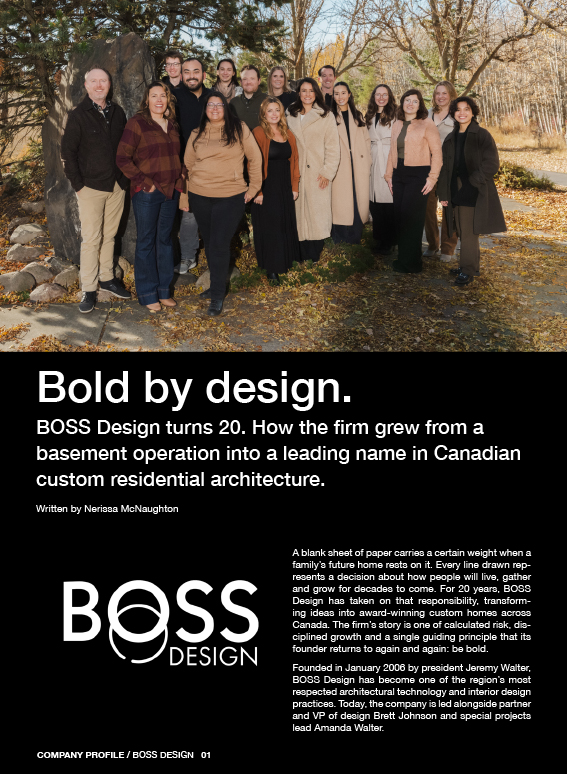
No firm sustains two decades of growth without a stable team, and BOSS Design treats staff retention as one of its clearest competitive edges. Two employees have been with the company for more than 15 years, and several others have crossed the 10 and eight year marks. That continuity, Jeremy says, has let the firm build reliable systems and deep competency, with a team that keeps learning and refining its offering together.
Leadership is deliberately cautious about who joins, weighing interpersonal skills as heavily as technical ability. The goal is to place the right people together and protect a culture that has taken years to build. The payoff is clearly visible in client satisfaction.
BOSS Design’s sense of responsibility reaches beyond its clients. The firm established its own charitable arm, The Build Project Foundation, partnering with Ronald McDonald House Charities Alberta, to confront a pressing shortage of housing for families in medical crisis.
At the local Ronald McDonald House, where families stay to be near their children who are undergoing lifesaving hospital treatments, the organization can meet only a fraction of the demand. To help close that gap, BOSS Design, together with Aspen Brick & Stone, secured two independent units in an apartment complex neighbouring the Edmonton House. The additional space allows the charity to house families who would otherwise sit on a waiting list while remaining connected to essential services such as meals and transportation. Funding comes largely through the foundation’s annual golf invitational, which covers the leases, furnishings and upkeep of the units.
The firm also supports children’s sports teams, sponsors community events and contributes NAIT scholarships to develop the next generation of designers.
As for what comes next, the leadership sees no reason to abandon a formula that has worked so well for two decades. Jeremy intends to keep pushing the envelope and adapting to the next technological wave, singling out artificial intelligence as a force he expects to shape the business in positive ways. Amanda and Brett share that outlook, aiming to take on increasingly complex projects while preserving the sustainable pace that carried the firm through its first two decades.
The milestone has also prompted reflection on the people who made it possible. Having been born and raised in St. Albert, Jeremy is quick to direct credit outward, thanking the community he has served his whole life, the clients who trusted the firm with deeply personal projects and the trades, suppliers and partners who grew alongside it. He reserves particular gratitude for the senior staff whose loyalty anchored the company through every stage of its expansion.
Twenty years in, BOSS Design offers a clear lesson in what patient, purpose-driven business looks like. Excellence, it turns out, is less about a single brilliant stroke than about persistence, sound decisions and a refusal to compromise on quality. The firm has expanded its reach across Canada without losing sight of the place where it started, proving that ambition and community can advance together. If the past is any guide, the next chapter will be written with the same boldness that defined the first – they will continue to be bold.